
What Happens If an Implant Screw Loosens? Symptoms, Causes and Treatment
Implant screw loosening can cause movement at the crown, bridge or abutment connection while the implant fixture remains stable in the bone. Movement in an implant-supported crown or bridge does not necessarily mean the implant itself is moving inside the bone.
To determine the appropriate treatment, the source of the movement must first be identified.
What happens if an implant screw loosens?
When the screw loosens, the implant fixture may remain stable in the bone, but movement can be felt in the crown, bridge or abutment connection. Early assessment may help prevent a minor mechanical issue from developing into more complex damage. dental implant page for more information. For related details, you can also read our bruxism and implants guide.
Movement may be felt in the restoration
The crown or bridge may feel slightly loose, click, or feel different during chewing.
It does not always mean implant failure
The implant in the bone may be stable; the problem may be in the prosthetic connection.
Early assessment matters
Chewing for a long time with a loose connection can place additional stress on the screw, abutment or restoration.
The level at which the connection has loosened should be assessed clinically.
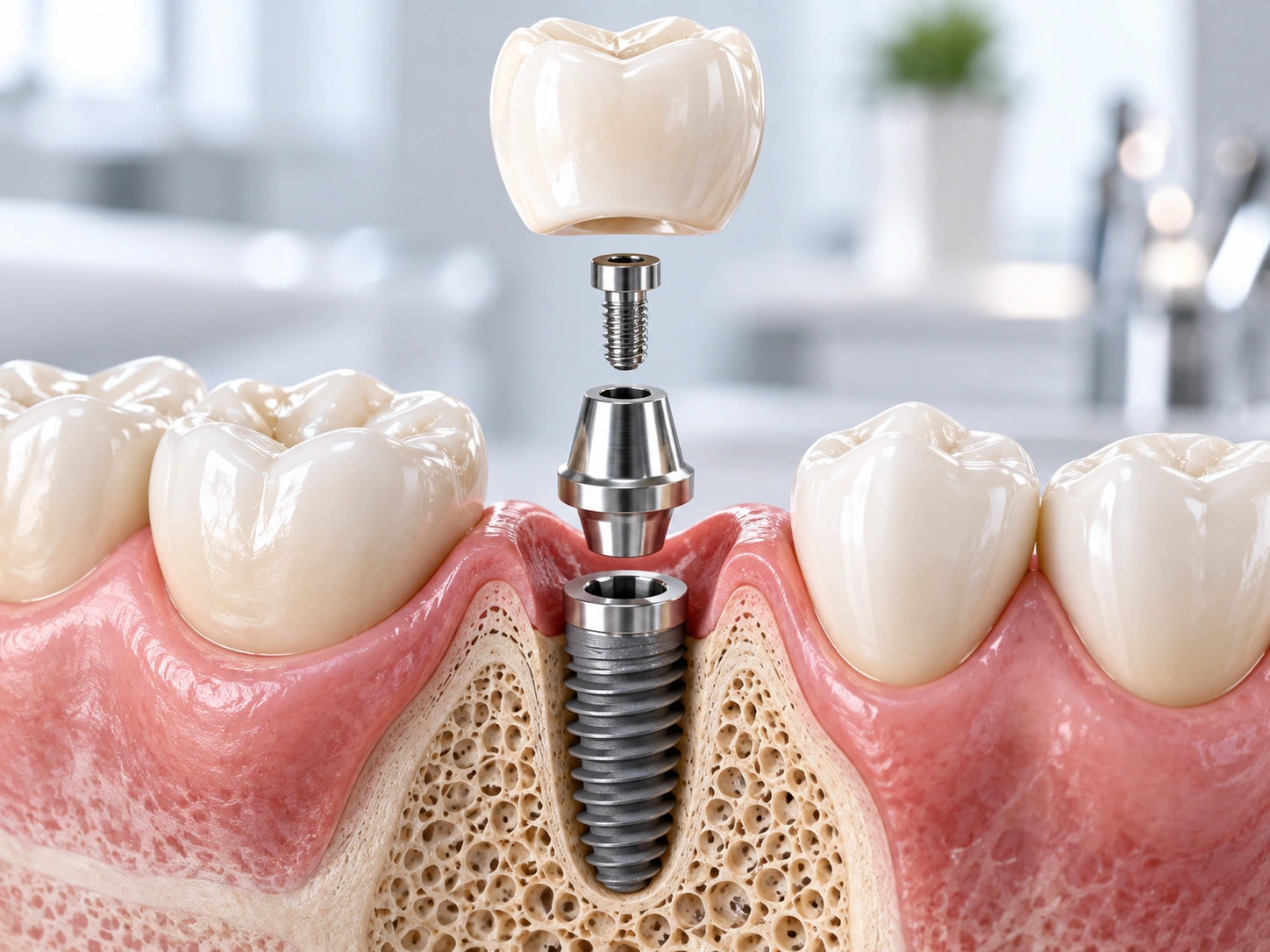
Is the implant itself loose, or only the tooth attached to it?
The movement a patient feels may originate from the implant fixture, abutment screw or restoration. This distinction changes the treatment plan considerably.
Movement of the implant within the bone is assessed for possible biological failure, whereas movement of the restoration with a stable implant is usually treated as a mechanical connection problem.
If the implant itself is moving
The stability between the bone and implant, and the surrounding bone support, are assessed. This differs from a simple loose screw.
If the crown / abutment / screw is moving
The implant may remain stable in the bone. The screw, abutment and restoration connection are checked mechanically.
How can you tell if an implant screw has loosened?
A loose screw does not always cause pain. New movement, clicking or a change in your bite may indicate that the mechanical connection needs to be checked.
Mechanical loosening can occur without pain.
An examination distinguishes movement of the implant itself from movement of the restoration.
Movement in the crown or bridge
You may notice new movement in a restoration that was previously fixed.
Clicking while chewing
Small movements at the connection may produce a sound or clicking sensation.
Change in the bite
The way the tooth contacts its opposing teeth, or its height, may feel different.
Discomfort while chewing
There may be local discomfort or a sense of instability without significant pain.
Noise around the restoration
A metallic or faint clicking noise may be heard when the crown or bridge moves.
New sensation of movement
New movement in a previously stable implant-supported tooth should always be assessed.
Why does an implant screw loosen?
Screw loosening does not have a single cause. Force distribution, connection components, restoration design and long-term use all need consideration.
Bite forces
Uneven or excessive chewing forces can repeatedly stress the connecting screw.
Bruxism / teeth clenching
Repeated high forces during the day or night can stress the mechanical connection.
Loss of screw preload
The clamping force keeping the connection stable may decrease over time.
Restoration design
Long bridges, cantilevers or uneven force distribution may affect the connection.
Component fit
The mechanical fit of the screw, abutment and connection surfaces also needs to be assessed.
Long-term use
Mechanical components may require maintenance, checking or replacement over the years.
Can teeth grinding loosen an implant screw?
Bruxism can create repeated high forces on implant-supported restorations. The risk of mechanical complications may increase, especially in the back teeth, in long bridges or where forces are not distributed appropriately.
The bite, restoration design and protective measures such as a night guard, when indicated, should be considered together.
Parafunction assessment
Load distribution on the restoration
What could happen if you continue chewing with a loose implant screw?
A seemingly minor looseness can lead to further damage to connecting components under repeated loading.
The screw can wear
Repeated micromovement in a loose connection can stress the screw surfaces.
The screw can fracture
Prolonged mechanical loading can result in screw fracture in some cases.
The abutment can be damaged
Connection surfaces and the abutment component may be exposed to additional stress.
The crown / bridge can be damaged
Cracks, fractures or connection problems may develop in the restoration.
Therefore, any newly noticed movement should be assessed without delay.

What do we check if an implant-supported tooth is loose?
The first priority is to locate the source of movement. We assess implant stability within the bone, the prosthetic connection, bite and mechanical condition of the restoration together.
Radiographs or other imaging methods are used when clinically indicated.
How does the assessment proceed?
We assess mechanical and biological findings step by step to identify the source of movement.
We ask when the movement, clicking, pain or bite change first started.
We assess the direction and extent of movement in the crown or bridge.
We distinguish movement of the implant fixture from movement of the restoration.
We check the connecting screw, abutment and compatibility of the components.
We examine tooth contacts and force distribution on the implant-supported tooth.
We consider bridge length, cantilevers and whether the restoration can be cleaned effectively.
Bone support and tissues around the implant are imaged according to clinical need.
We plan retightening, component replacement, restoration adjustment or further assessment as appropriate.
How is a loose implant screw fixed?
Treatment depends on the source of movement and the condition of the connecting components.
After checking the connection and components, the screw may be retightened to the appropriate torque.
If the screw is deformed or worn, a replacement may be needed.
The affected component may need replacing, or the restoration may need adjusting or remaking.
This is not treated as simple screw loosening; it requires separate assessment for implant failure.
Is retightening the implant screw always sufficient?
No. If the screw is simply tightened again without investigating why it loosened, the underlying mechanical cause may persist.
Bite
We check for excessive or premature contacts.
Bruxism
We assess whether repeated high forces are affecting the connection.
Components
We inspect the screw, abutment and connection surfaces mechanically.
Restoration design
We review bridge length, cantilevers and force distribution.
What happens if an implant screw breaks?
The position of the broken screw fragment and the condition of the implant’s internal connection are assessed. In suitable cases, the fragment can be removed from the implant and the connection may be reused.
A broken screw does not always mean the implant must be removed; implant stability and damage to the internal connection are important.
Common misconceptions about loose implant screws
“If an implant moves, it definitely has failed.”
Movement does not always originate from the implant fixture; the prosthetic connection may be moving.
“Screw loosening is normal.”
If loosening recurs, the underlying mechanical cause should be investigated.
“Once tightened, it will never loosen again.”
Loosening may recur if factors such as bite forces or bruxism persist.
“If there is no pain, there is no problem.”
Mechanical loosening may occur without significant pain.
“If a screw loosens, the implant must be removed.”
If the implant is stable in the bone, the prosthetic problem may be treated separately.
Can an implant screw become loose again?
Screw loosening may recur if the underlying cause persists. Identifying the mechanical cause is therefore an important part of long-term success.
We assess premature or excessive contacts on the implant-supported tooth.
We examine clenching or grinding habits in relation to mechanical loading.
We monitor the screw, abutment and connection surfaces.
Recurrent movement or clicking is assessed early.
Can screws loosen in full-arch implant restorations?
When loosening is identified in one connection of a fixed full-arch restoration, we assess not only that screw but also the passive fit of the restoration, bite and other connections.
Loose screw
The connection is checked, but we also investigate why the problem keeps recurring.
Passive fit and force distribution
For All-on-4 / All-on-6 restorations, the fit and bite of the entire framework are assessed together.
Can the screw of an implant placed at another clinic be checked?
Yes. The connection problem may be assessed as far as the existing implant system and restoration can be identified and evaluated. However, availability of the appropriate screw, abutment or specialised driver depends on the implant brand and connection system.
An implant passport, previous treatment record or details of the system used can make assessment easier.
Common questions about implant screw loosening
Does a loose implant screw mean the implant itself moves?
Can a loose implant screw be retightened?
Why does an implant-supported crown move?
Does implant screw loosening cause pain?
Why does the implant screw keep loosening?
Can clenching loosen an implant screw?
Can I eat with a loose implant screw?
Does a broken implant screw mean the implant must be removed?
Does screw loosening mean the implant did not integrate?
Can a screw in an implant placed elsewhere be tightened?
More guides on implant health and restoration issues
Implant Aftercare and Healing

What Happens if an Implant Fails?

What Is Peri-implantitis?
Fixed Zirconia Restorations on Implants
Dental Implant Treatment Process

Does Smoking Affect Implant Success?

Do you feel movement in your implant-supported tooth?
Identifying whether the implant itself or only the crown, bridge or screw connection is moving is the first step in planning treatment. You can send us your existing X-ray and, if possible, a short video or photo via WhatsApp.