FOR HEALTHIER SMILES
Dental Implant Treatment in Kuşadası
Dental implants can provide a long-term option for replacing missing teeth. Treatment is planned following a clinical examination and, where indicated, 3D imaging and digital assessment.
Specialist Dentist
Natural Aesthetics
Near Kuşadası Marina
FOR A HEALTHIER TOMORROW
What is a dental implant?
A dental implant is a fixture, typically made from titanium, placed in the jawbone to support a replacement tooth or other dental restoration. It may be used to replace a single tooth or support a bridge or full-arch prosthesis, subject to clinical suitability.

Strong Chewing Function
Implant-supported restorations can help restore
chewing function, depending on the treatment plan and individual oral health.

Natural, Aesthetic Appearance
Final restorations are carefully designed to harmonize with dental structure,
facial proportions, and smile aesthetics.

Supports Jawbone Preservation
The implant helps transfer functional chewing loads
to the bone in the area of missing teeth.
Which dental implant treatment is right for you?
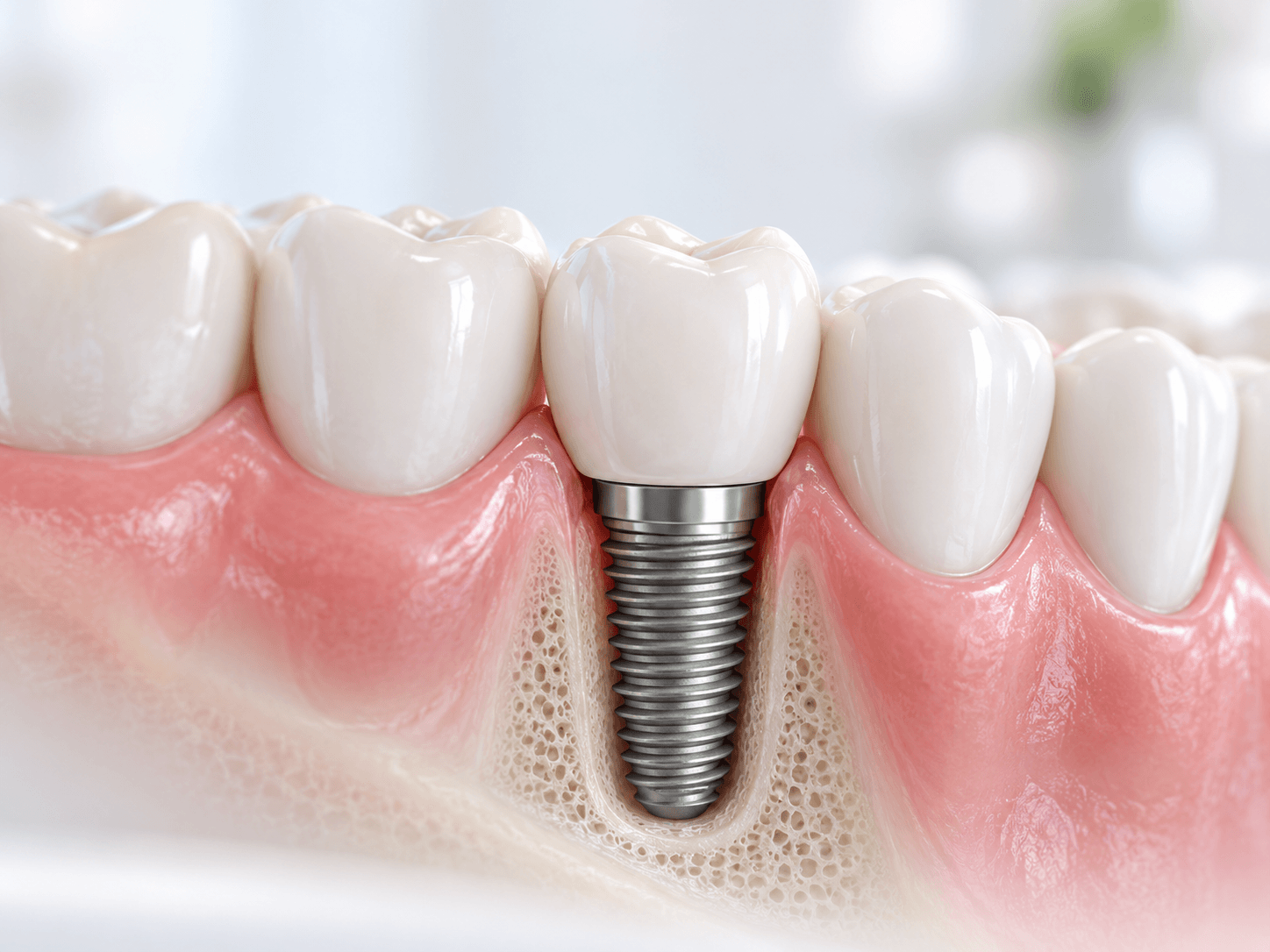
Single Tooth Implant
A treatment option for replacing a single missing tooth without preparing adjacent healthy teeth for a conventional bridge.
You can compare the advantages and limitations of an implant versus a traditional bridge for a single missing tooth in our implant or bridge? guide.

Multiple Missing Teeth
Implant-supported crown and bridge options can be evaluated
for replacing multiple missing teeth.

Implant-Supported Bridge
Can replace multiple adjacent missing teeth
using fewer dental implants.

All-on-4 / All-on-6
A comprehensive treatment approach planned with four or six implants
to support a fixed full-arch restoration.
The implant treatment process

Examination & CBCT
Your current oral health is evaluated through a thorough clinical examination
and 3D imaging (cone-beam computed tomography, CBCT), when indicated.

Digital Planning
Implant positions are planned digitally according to bone structure
and the type of final restoration. In suitable cases, digital planning facilitates approaches such as surgical guides and flapless implant surgery.

Implant Placement
The selected implants are surgically placed into the planned
locations. The placement duration for a single implant may vary depending on the case and surgical protocol applied.

Healing Process
The osseointegration process, essential for the implant to bond with bone,
is carefully monitored. Healing times vary based on bone quality, implant location, and any additional procedures performed; most cases require a healing period of a few months.

Final Zirconia Restoration
After healing, the final crown, bridge, or full-arch restoration is prepared and fitted. The number and timing of appointments depend on the restoration and individual clinical needs.
ELEVATING CARE WITH TECHNOLOGY
Implant treatment planned with digital technology
By utilizing 3D imaging and digital impression technologies
in implant planning, we aim to evaluate anatomical structures with greater detail
and ensure a more predictable course for the restoration
process.
For long-term implant success, not only its position in the bone
matters, but also the design of the crown or bridge placed over it.
At Adaport Dental Clinic, Prosthodontist
Dr. Mehmet Köse, Specialist in Prosthodontics
brings dedicated expertise to evaluating chewing forces,
relationships with adjacent teeth, cleanability,
and aesthetic requirements for implant-supported restorations.
Surgical suitability is determined through clinical examinations and required radiological
assessments.
An implant is not the only option for every missing tooth. For suitable patients,
tooth-supported bridges or alternative treatment options can also be considered.
You can explore which approach may be better suited for your needs
in detail in our
implant or bridge?
guide.
The prosthetic options and long-term component availability
of the selected implant system are also integral to the treatment plan;
in our
dental implant brands
guide, we compare Straumann, Neodent, and Osstem/Hiossen
systems.
- 3D imaging with CBCT
- 3Shape TRIOS digital intraoral scanning
- Digital impression and restoration planning
- Multilayer zirconia restoration options
Frequently asked topics about dental implants

Dental implant or bridge?
In which situations is an implant preferred, and when is a bridge chosen?
Read more →

How long does implant treatment take?
Treatment phases and factors influencing overall duration.
Read more →

Recovery after dental implants
How does healing progress, and what precautions should be taken?
Read more →

Differences between All-on-4 and All-on-6
What are the key differences between these two treatment approaches?
Read more →

When is a bone graft required?
What supplementary procedures can be considered when bone volume is insufficient?
Read more →

Implant-supported zirconia crowns
Application areas of zirconia restorations over dental implants.
Read more →

How long does pain last after dental implant surgery?
Typical tenderness, swelling in the first few days, and normal healing progression.
Read more →

Does smoking affect implant success?
The effects of smoking on the healing process and implant longevity.
Read more →

What is done if there is not enough bone for an implant?
How bone grafting and alternative surgical techniques are evaluated when bone volume is low.
Read more →
FREQUENTLY ASKED QUESTIONS
Frequently Asked Questions About Dental Implants
We answered the most common questions from our patients regarding
dental implant treatment, healing, bone structure, implant types,
and planning treatment in Kuşadası.
What is a dental implant, and how is it placed?
A dental implant is a biocompatible titanium fixture anchored into the
jawbone to replace missing teeth. Following osseointegration, a customized
crown, bridge, or fixed full-arch restoration can be fabricated over it.
Prior to treatment, clinical assessment and 3D imaging evaluate bone quality,
implant positioning, and the final restorative plan.
Is dental implant treatment painful?
Implant surgery is generally performed under local anaesthesia to minimise pain during the procedure. Mild tenderness, swelling,
or minor discomfort may occur for a few days after surgery.
This varies depending on the number of implants placed, the surgical scope,
and individual healing rates.
How long does dental implant treatment take?
Surgical placement of the implant is typically only the first phase of treatment.
A healing period is often required for the implant to integrate with the bone
before the final restoration can be attached. This timeframe varies based on bone structure,
implant location, and any concurrent surgical procedures. In appropriate cases,
temporary fixed restorations may also be considered.
You can review the dental implant treatment process in detail.
Do I need an implant for every missing tooth?
No. When several adjacent teeth are missing, it is not always necessary
to place an individual implant for each tooth. In suitable cases,
a fixed implant-supported bridge can be secured over a designated number of implants.
The required number of implants is determined by bone structure, the location
of missing teeth, bite forces, and the overall restorative plan.
What happens if there is not enough bone for an implant?
When there is insufficient bone height or width in the implant area,
bone grafting, sinus lifting, or alternative surgical approaches
can be considered. The most appropriate technique is determined after
evaluating bone volume and anatomical structures via 3D CBCT imaging.
Is a bone graft necessary for every dental implant patient?
No. Bone augmentation may be recommended when the existing bone volume is inadequate
to place the implant securely and in an optimal position.
When bone support is adequate, additional augmentation may not be required.
The decision is made following a clinical exam and CBCT assessment.
Is an implant better or a dental bridge?
Both implants and fixed dental bridges can be suitable options depending on the clinical scenario.
An implant replaces a missing tooth without altering adjacent healthy teeth.
A bridge, on the other hand, may be an alternative in cases where surgery is not preferred
or where adjacent teeth can provide strong support.
The choice depends on bone condition, health of adjacent teeth, occlusion,
general oral health, and individual treatment goals.
What is the difference between All-on-4 and All-on-6 implants?
In the All-on-4 approach, a fixed full-arch restoration is supported by four implants,
while the All-on-6 approach utilizes six implants.
The choice of implant count is not merely a matter of preference;
bone volume and density, implant distribution, chewing forces,
the opposing arch, and final prosthesis design are all assessed collectively.
You can review the differences between All-on-4 and All-on-6 in detail.
What should I be mindful of during the post-implant recovery period?
In the initial days after surgery, it is important to protect the treated area
and adhere strictly to your dentist’s oral hygiene and dietary recommendations.
Consistent oral hygiene, follow-up appointments, and maintaining the health of tissues
around the implant are essential for long-term success.
Smoking and excessive mechanical pressure can negatively affect healing.
You can review our post-implant care and recovery guide.
How long do pain and swelling last after implant surgery?
Mild to moderate tenderness and swelling can be expected during the first few days
after implant surgery. Recovery depends on the extent of the surgical procedure,
the number of implants placed, and individual healing rates.
If symptoms persist longer than expected or worsen over time,
your treating dentist should be consulted.
Does smoking affect the success of dental implants?
Smoking can compromise intraoral tissue healing and the long-term health
of the tissues surrounding the implant. In particular,
smoking during the early postoperative period is considered a significant risk factor.
This factor is carefully taken into account when designing implant treatment plans
for patients who smoke.
How long do dental implants last?
There is no single fixed lifespan for dental implants. Meticulous oral hygiene,
regular dental check-ups, smoking habits, teeth grinding or clenching,
bone and gum health, and the bite alignment of the restoration all influence
long-term outcomes. Routine monitoring of peri-implant tissues is vital.
What type of tooth restoration is placed over an implant?
For single-tooth loss, a custom crown is placed over the implant.
For multiple missing teeth, fixed implant-supported bridges are used,
and for complete edentulism, full-arch fixed implant restorations
can be designed. In selecting the final restoration, aesthetics,
chewing function, occlusion, and implant positions are evaluated together.
What factors determine the cost of dental implants?
The total cost of dental implant treatment varies depending on the number of implants,
the implant brand and system used, whether additional surgical procedures such as
bone grafting or sinus lifting are needed, and the type of crown, bridge,
or full-arch restoration selected. Therefore, an accurate cost can only be determined
through a personalized treatment plan following clinical and radiological evaluation.
How many days do I need to stay in Kuşadası for implant treatment?
Implant treatments are generally planned in two stages. During the first visit,
clinical examinations, 3D imaging, and implant surgery can be completed.
On the second visit following the healing period, digital impressions,
try-ins, and final restorations are completed.
The required length of stay in Kuşadası is determined individually according to the number of implants,
additional surgical procedures, and the specific restoration planned.
You can read more about travel durations for implant treatment in Kuşadası.
LET’S TAKE THE FIRST STEP TOGETHER
Let’s plan your implant treatment together in Kuşadası
Share your X-ray with us or book a consultation appointment
at our clinic. We will design personalized implant treatment options
by evaluating your bone structure, missing teeth, and expectations.
Digital Workflow
Prosthodontic Expertise
Near Kuşadası Marina
